Human perception is not a passive recording of reality but an active process through which the brain organizes sensory input into coherent, meaningful experiences. Rather than seeing isolated colors, sounds, or movements, we perceive objects, actions, causes, and intentions. This remarkable ability allows us to navigate complex environments quickly and efficiently, often without conscious effort.
Gestalt Principles and Perceptual Grouping
A central concept in understanding human perception is Gestalt psychology, which emphasizes that we perceive wholes rather than separate parts. According to Gestalt principles, the brain uses built-in rules to organize visual information:
- Proximity: Elements that are close together are perceived as a group.
- Similarity: Objects that look alike are seen as related.
- Closure: We mentally complete incomplete shapes.
- Continuation: We prefer smooth, continuous patterns over abrupt changes.
These principles explain why logos, symbols, and visual designs can be understood instantly. The brain automatically performs perceptual grouping, creating order from potentially chaotic input.
Synchronization and Common Fate
Perception also relies heavily on timing. Events that occur simultaneously or move in the same direction are perceived as belonging together, a principle known as common fate. For example, a flock of birds appears as a single unit because the individuals move cohesively. This mechanism helps us detect meaningful structures even in noisy or cluttered environments.
Recognizing Biological Motion
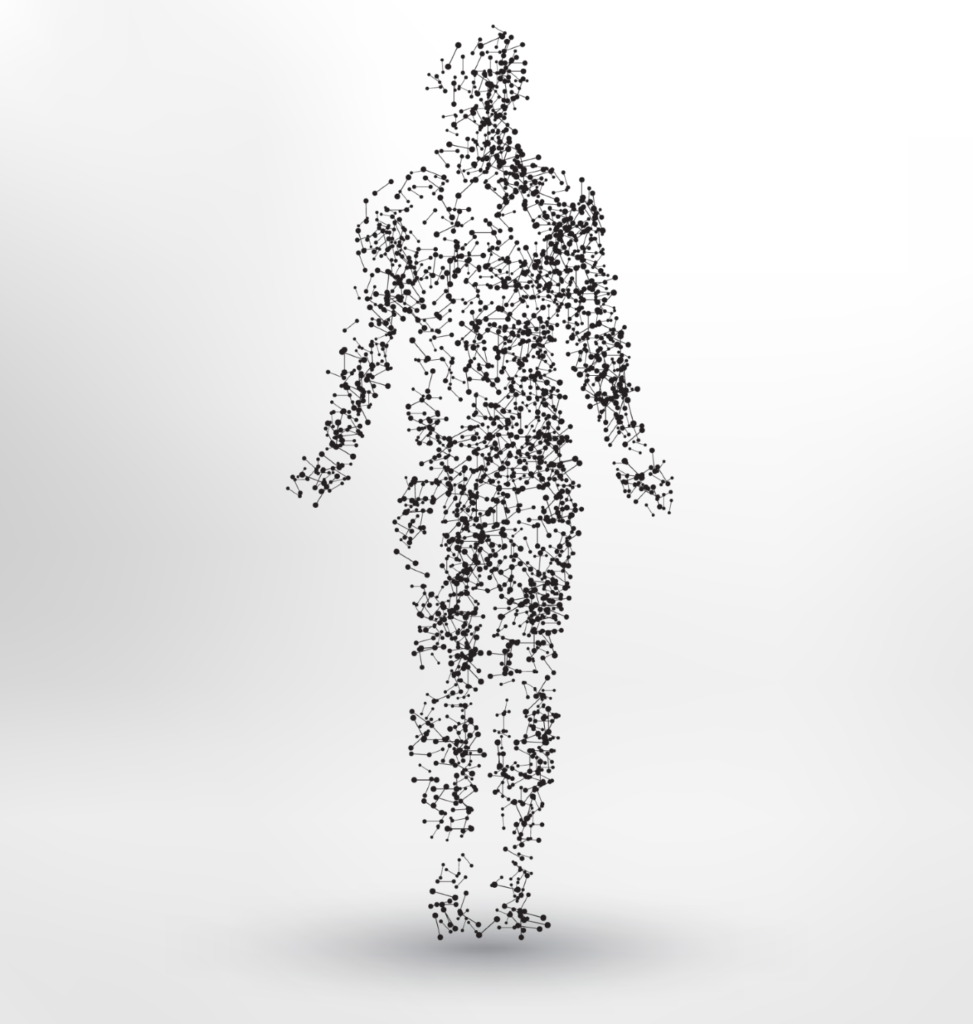
Humans are especially sensitive to biological motion perception. Even when a person is represented only by a few moving points of light placed on joints, observers can recognize a walking human, infer gender, mood, or activity, and distinguish human movement from mechanical motion. This ability suggests that our perceptual system is tuned to detect living agents, which has clear evolutionary advantages for social interaction and survival.
Detecting Agency and Animacy
Our brains are quick to attribute intention and life-like qualities to moving objects, a process known as agency detection or animacy perception. If one object appears to chase another, we instinctively interpret the movement as purposeful rather than random. Children, in particular, readily assign intentions to inanimate objects. This tendency reflects the human mind’s bias toward interpreting motion as evidence of goals, desires, or consciousness.
Perceiving Causality
Human perception also constructs cause-and-effect relationships from visual events. When one object collides with another and the second object immediately moves, we perceive the first as causing the motion. This perception of causality depends strongly on spatial proximity and timing; if the delay is too long, the sense of causation disappears. Such rapid causal inference helps us understand events without deliberate reasoning.
Unconscious Processing and the Sense of Agency
Not all perceived actions originate from conscious decisions. Research shows that many actions begin at a subconscious level before we become aware of intending them. Phenomena such as the ideomotor effect demonstrate that people can produce movements unconsciously while still experiencing a sense of voluntary control. This creates an illusion of conscious will, revealing a gap between actual neural processes and our subjective experience of agency.
Summary
Human perception is a powerful system for transforming raw sensory data into meaningful objects, events, and relationships. Through Gestalt principles, motion analysis, agency detection, causal inference, and unconscious processing, the brain constructs a coherent reality that guides behavior and social interaction. Much of this organization happens automatically and outside conscious awareness, highlighting both the efficiency and the limitations of our perceptual system. Understanding these processes deepens our insight into cognition, design, communication, and the nature of human experience itself.
While these mechanisms operate automatically in everyday perception, they become even clearer when examined through specific visual examples. Gestalt principles show how simple shapes, spacing, and movement can dramatically change what we perceive and how we interpret meaning from visual scenes. To better understand how these principles work in practice – from design to everyday objects – explore real-world examples of Gestalt principles here:
https://mindhackteam.com/gestalt-principles-examples/